
Latest Shots #


Latest Blog Posts #
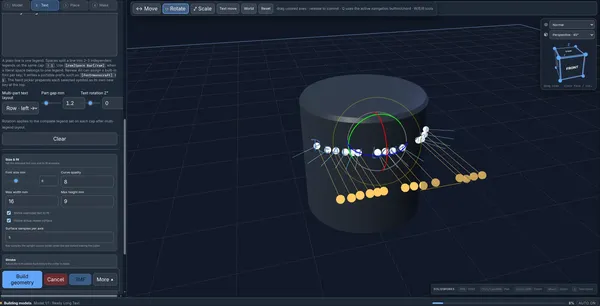
Stl Text Lab Update
Keys.waylonwalker.com
Malicious Aur Packages Jun 2026
Prompt Seagulls
agents are never done
Recent TIL #
I’m playing with omarchy on an old laptop and decided I want to share it with my kids without sharing what I also set up as my sudo password.
Lsblk -f
Look for the one labeled crypto_LUKS
Sudo cryptsetup luksChangeKey /dev/nvme0n1p2
Then you will be asked for your sudo password, previous full disk encryption password, then the new one twice.
Now my laptop can be shared without sharing my private sudo password.
First Find your usb disk. You should be able to identify it by size and name using lsblk.
lsblk -o NAME,SIZE,MODEL,TRAN,RM,MOUNTPOINTS
Here I see my good ol Trans-It Drive. It’s not fancy, it wasnt even at the time it was new, but I have it and it works. next we run the disk destroyer dd to copy raw bytes right on to the drive.
Warning
This is a full reformat of the drive, nothing on the drive will be recoverable afterwards. I keep this drive around as a boot disk and it just changes distro occasionally.
sudo dd if=~/Downloads/omarchy-4.0.1.iso of=/dev/sdb bs=4M status=progress conv=fsync
Note
Don’t forget the bs, the default block size is so slow it will take an eternity to copy a linux iso on to a boot drive.
Installing omarchy #
I wanted to give omarchy quatro a try, here is the session to get it.
~ NO PYTHON VENV SET USING SYSTEM NVIM
❯ lsblk -o NAME,SIZE,MODEL,TRAN,RM,MOUNTPOINTS
NAME SIZE MODEL TRAN RM MOUNTPOINTS
sda 119.2G SAMSUNG MZNLN128HAHQ-000H1 sata 0
├─sda1 1G 0
└─sda2 118.2G 0
sdb 7.6G Trans-It Drive usb 1
├─sdb1 5.8G 1
└─sdb2 23M 1
zram0 93.9G 0 [SWAP]
nvme0n1 931.5G Samsung SSD 980 1TB nvme 0
├─nvme0n1p1 1G nvme 0 /boot
└─nvme0n1p2 930.5G nvme 0 /var/log
/var/cache/pacman/pkg
/home
/
~ NO PYTHON VENV SET USING SYSTEM NVIM
❯ sudo dd if=~/Downloads/omarchy-4.0.1.iso of=/dev/sdb bs=4M status=progress conv=fsync
Helix has got to have one of the easiest configurations. It is this easy to get the markata-go lsp in helix.
markata-go lsp setup --editor helix
# Helix languages.toml (usually ~/.config/helix/languages.toml)
[language-server.markata-go]
command = "markata-go"
args = ["lsp"]

[[language]]
name = "markdown"
language-servers = ["markata-go"]
I don’t run into windows file endings very often, so when I see little ^M’s
all over your file, I think “shit I know what these are and cant remember”
They represent the windows carriage return.
Linux vs Unix Line Endings #
The difference here is that Unix uses \n and Linux uses \r\n, going all the
way back to the typewriter it represents the two keys that a typist would have
to press to get a new line and return the carriage back to the beginning.
Vim/Neovim #
When I open up a file and see this garbage all over, its not cozy, I want them gone, I dont want them all over my editor. I’m not sure what this would look like on windows, I haven’t been able to afford a windows machine in years, but its gross on my machine.
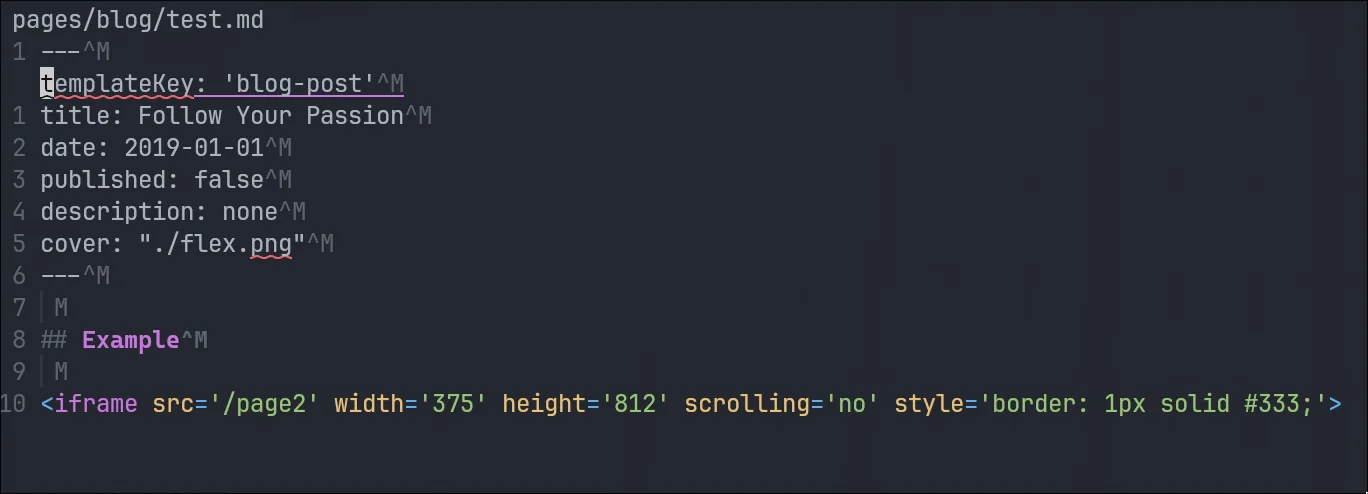
Remove them with a substitution command from normal mode.
:%s/\r//g
removing carriage returns with a substitution command
I ran into an issue where my pinentry was unable to connect, blocking me from
doing commits. You can use this to continue signing commits.
export GPG_TTY=$(tty)
gpg-connect-agent updatestartuptty /bye

printf test | gpg \
  --local-user 9A47900E81415D65C32C630066E2BF2B4190EFE4 \
  --pinentry-mode loopback \
  --sign >/dev/nul
I’ve been running fedora coreos on my home servers for awhile. I really liked
the stability I got from bazzite, and have since enjoyed the stability of
fedora coreos. Since it’s an immutable system I’ve never quite known if I need
to reboot or not, and was unsure how to check for updates. Today I learned you
can use rpm-ostree status to see if your
fedora coreos system is up to date.
rpm-ostree status
For me it listed security advisories with a count of each severity unknown, low, moderate, and important.
This morning I had a machine crash on me and came back to an error.
Error
zsh: corrupt history file /home/u_walkews/.zsh_history
Dammit I don’t want to redo my shell history, I checked with a clanker and they
came up with this solution using strings that only prints printable
characters.
cp ~/.zsh_history ~/.zsh_history.bak
mv ~/.zsh_history ~/.zsh_history.corrupt
touch ~/.zsh_history
chmod 600 ~/.zsh_history
strings ~/.zsh_history.corrupt > ~/.zsh_history
chmod 600 ~/.zsh_history
Just give em the ol one eyed fighting Kirby
This is a vim substitution technique to capture the rest of the line as a capture group.
:'<,'>s/longhorn\(.*\)/longhorn\1-rwx
This one captures pesky optional " and places it back at the end if it found
one.
:'<,'>s/longhorn\("\?\)\(.*\)/longhorn\2-rwx\1
!!! see-also
The One Eyed Fighting Kirby