Agents suck
Get left behind if you don't use them
Burn out if you use them too much
The software world has been flipped upside down seemingly overnight. Slow at
first, then all at once. It started with auto complete, to chat, to, ide
integrations, to agents that would f&!^ over your repo more than it would help.
Up till this point we are just little bit better and more specific than copy
paste from Stack Overflow. Then in Nov 2025 models learned how to effectively
use tools and do what you ask of them, sometimes more, sometimes less, but
generally for the basic shit most of us make its a net positive with each
iteration.
Our techniques for managing work need to change.
Our expectations need to change.
Burnout for a lot of folks is coming.
I saw today in work chat something along the lines of "we need bigger context
windows" "compaction times are holding us back". Maybe I'm just blessed with
the lack of lord jira, maybe juggle too many projects at once and they are all
pretty much done when I get back. Maybe I do more long running specs and spend
time making good plans that it does not matter.
Anyways the point I'm getting to is that if you think that compaction is your
main issue slowing you down, and 10x this if you are a manager thinking this is
what is slowing down your team you **need** to look at your workflow. Not
because it sucks. Not only because it could be better. Because you are
signing yourself and your team up for burnout if you are sitting there watching
these things run like waiting for paint to dry and firing more prompts at them
as soon as they are done. It feels easy. It feels like you are going fast.
Its eating more brainpower than you think, and its not getting you to your
destination any faster.
Part of @steveyegge 's gastown/beads is a prompt "Lets land the plane". It's very straightforward forward and what any sane human would probably do before finishing work, except the last part. The "generate a handoff prompt for the next session" was not something I've put much thought into. But now that I juggle 6 sessions at a time and often end up with 20 sessions open because I don't want to close them and loose the last bit of context. This is what I need to keep from crippling my laptop memory from all of these stale sessions hanging around.
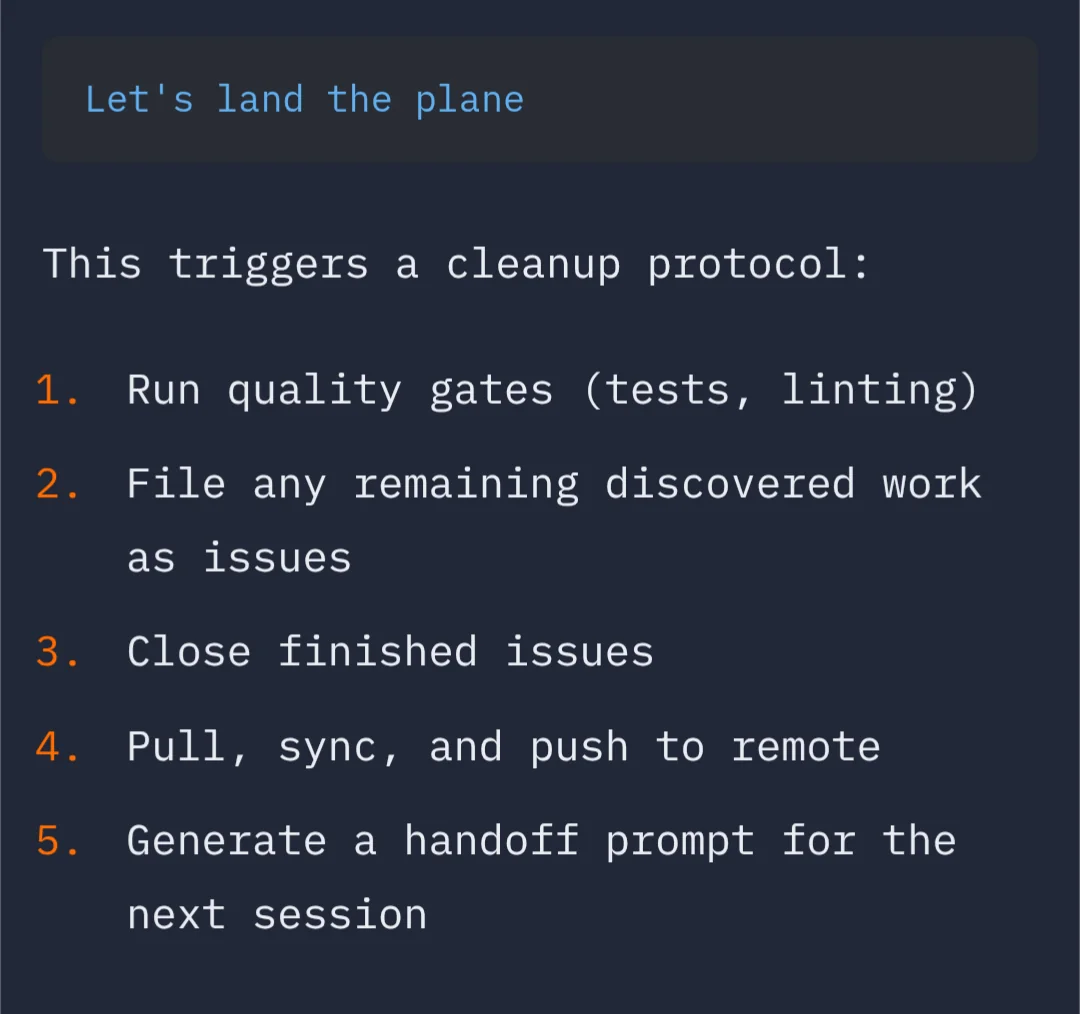
Taken from https://ianbull.com/posts/beads
When agents do the work its harder to recognize a dead end.
All we are hearing lately is Agents are the future, something flipped around
NOV 2025 with opus 4.5. It turned snake oil into action. It changed
programmers will be replaced in 6 months to now. Not all of them, but probably
most of us who are not extraordinary. If you fall into the camp of folks not
adopting, I got no issues with that. No one is twisting your arm, well maybe
your boss or cto is, thats on them. I don't mean to say this is the future as
in, get in or get left behind. I mean it as this is where your other engineers
probably are, the junior to mid level engineers are here. If you are not
trying to meet them where they are how are you going to lead them.
I just stumbled into an image in my org chart of someone who clearly turned
themself into a Studio Ghibli character in chatgpt during the small window of
time that it seemed to do this for everything. Its clearly the aesthetic that
It would do by default for that week, then would not do it whatsoever. I'd
link it, but its from an org chart. I mostly found it interesting how we now
have these recognizable artifacts from specific moments in time.
I feel like there's an inevitable phase to every ai/agentic worked feature/epic
where you have to get in and chat with it 2025 style (except it actually works
and doesn't turn your project to shit). Planning is great, planning out epics
for full orchestrator's to churn for hours on is amazing, but it always leaves
me with a handful of thorns multiplied by complexity level of things that I
can shout a list of 6 items at a time that it can one shot. I haven't seen
anyone put a name to this phase yet, so I'm going to call it the UAT phase
for now and it seems like a very necessary part of the SDLC. It was
important before, but feels more so now as engineers distance themselves
from the implementation.
I heard this term yesterday, and I think a lot of people are missing out on
step 1. It's important to experiment with agents and learn what they can do
well and what they cant, this changes every couple of weeks at this point. You
might be spending hours planning something that could have been implemented
right away, or maybe wasted time planning something that needed more research,
more context engineering. Agents start fresh every session, they cant remember
what you asked them to do 5 minutes ago in the other session, getting the right
tokens in session is critical.
I wrote some code by hand on Sunday. Sat down with my son and started building
out a game in pygame from scratch. We went to google, we searched how to do
something, we copy and pasted from the docs. Not because we are dumb, but
because we cant remember some aspects of the pygame api. Now that these
patterns are established we no longer have to google them, we simply grep our
codebase and replicate the pattern. Easy right? It's funny that it took ai to
coin the term `context poisoning` even though it was there all along.
Agents cannot replace the thinking, they only amplify it. If you set the
agents off in the wrong direction that's where they will go. They will sprint
there faster than you can go. This is ok, its one of their advantages, they
can give you signal quick. Remember if they are off in the wrong direction
more research and planning is needed, and maybe a little bit more thinking on
your end to steer them in the right direction.
Thinking about AI productivity again. It's allowing massive amounts of work to
get done, to levels that humans cannot physically type out in some cases. But
not all of this work is necessarily high value work. Right now I'm working on
one of the biggest PRs to an internal cli library. Probably the largest PR
I've ever done professionally. It touches all of the cli, refactors every
command, reaches into the business logic layers to drive deeper separation. I
reaches into the common layers to drive consistency. It ensures that every
command (50 or so) has similar flags, supports --plain, --no-color. It specs
out contracts to ensure that data goes out stdout, any extra goes out stderr.
This makes everything unix pipe friendly. There was quite a bit of research and
prep that went in, that turns out to already be distilled down into clig.dev.
The point is that this is all good work. It will make the product consistent,
repeatable, expected, and most of all boring. Most of the time, it wi...
Here's something I've been wrestling with lately. I keep hearing people come
to the realization that they never liked coding, they thought they did, but
secretly hated it the whole time. I dont think I've ever kidded myself about
this. I like building things. I like having an idea and see it come to life.
Just because I like the end product more, and that coding really was a means to
an end, something I will never do again in the same capacity that I have in the
past, does not mean I did not enjoy the art of solving problems by typing
syntax into a file to tell a computer how to solve a problem.
The only thing that seems interesting is AI right now, I'm writing less code,
and I kinda just don't care as much about the small open source stuff as I used
to. I enjoy reading about what other people are thinking, doing, creating.
But when I go to grab a podcast while I wait on my clankers its one talking
about how other people are using them, how to make them more secure, more
effective, how the new models change things, what models are good at what.
It's all so new and changes so fast. Any sort of new open source project
starts out sus that it was just vibe coded anyways, So at the moment it feels
like ooh how did you get that, how do I make mine, and that the thing itself
has less value. I hate that its this way, but it is.
AI is moving so fast this year its hard to keep up, I've written 3 or 4
versions of one blog post to replace I'm Out On Agents [1], but it feels like
everything changes before I can get it out.
References:
[1]: /im-out-on-agents/
What you don't have six agents orchestrating the work of 6 subagents yet. I
saw in a work chat that people were complaining about 5.4 being too slow and
they keep going back to opus. For me its been working great, I have it working
on critical infrastructure work, that I will need to maintain. I appreciate
its accuracy and completeness. And honestly I'm **rarely** watching agents
run. Its like watching paint dry at this point. Its interesting to read their
thinking prompts, but not productive work. While its running I'm teeing up the
net prompt. Working with another set of agents to write a set of issues for
the next epic. I might be too privileged though. I own a whole platform and
have plenty of autonomy to work on what I see fit for the day. I don't have a
boss breathing down my neck waiting for a single ticket to be complete. I'm
working on 6 projects at a time. I'm taking walks to avoid becoming a burnt
out zombie. I'm definitely not complaining about it kicking out massive
amo...
In November 2025 everyones beard lost its color, we aged into the next
generation without realizing it. If you were getting paid to write code at
this point in time, you are part of a special point in history where we used to
write code by hand. There will be systems air gapped systems somewhere devs
will continue to do it how we've always done it, some day they will peek out of
this cave and realize that they are the only ones left, no one else remembers
what its like. Writing code will quickly become a hobby that people do, in a
weird niche way. Not because you want to build something, but like the guy
with a mainframe in his garage that likes to watch the lights blink. Because
its nostalgic, it's a very cool skill, its fun and rewarding, but it won't be
to get something done.
I spent all day grinding on a 20 minute fix. I want the agents to do it. They
can do it, but they are missing the harnesses they need to replicate my
workflows of old.
I was today years old when I realized that the ghostty guy is the Hashicorp guy.
I taught wyatt `#bada55` green, I apologize in advance, I underestimate
the power of immature humor has on him.
Agents right now
* can I access the project you mentioned?
> yes
* Can i access /tmp
> yes, just do it
* While I'm I at it, `kubctl delete...`
> yanks plug front internet
Calendar data could not load. Try again.